Watch the Full Video Explainer
Prefer reading? The full breakdown of LLM model fusion is below, from offline model merging to OpenRouter Fusion at the API level.
The Single-Model Bottleneck: Why Training Hits a Wall
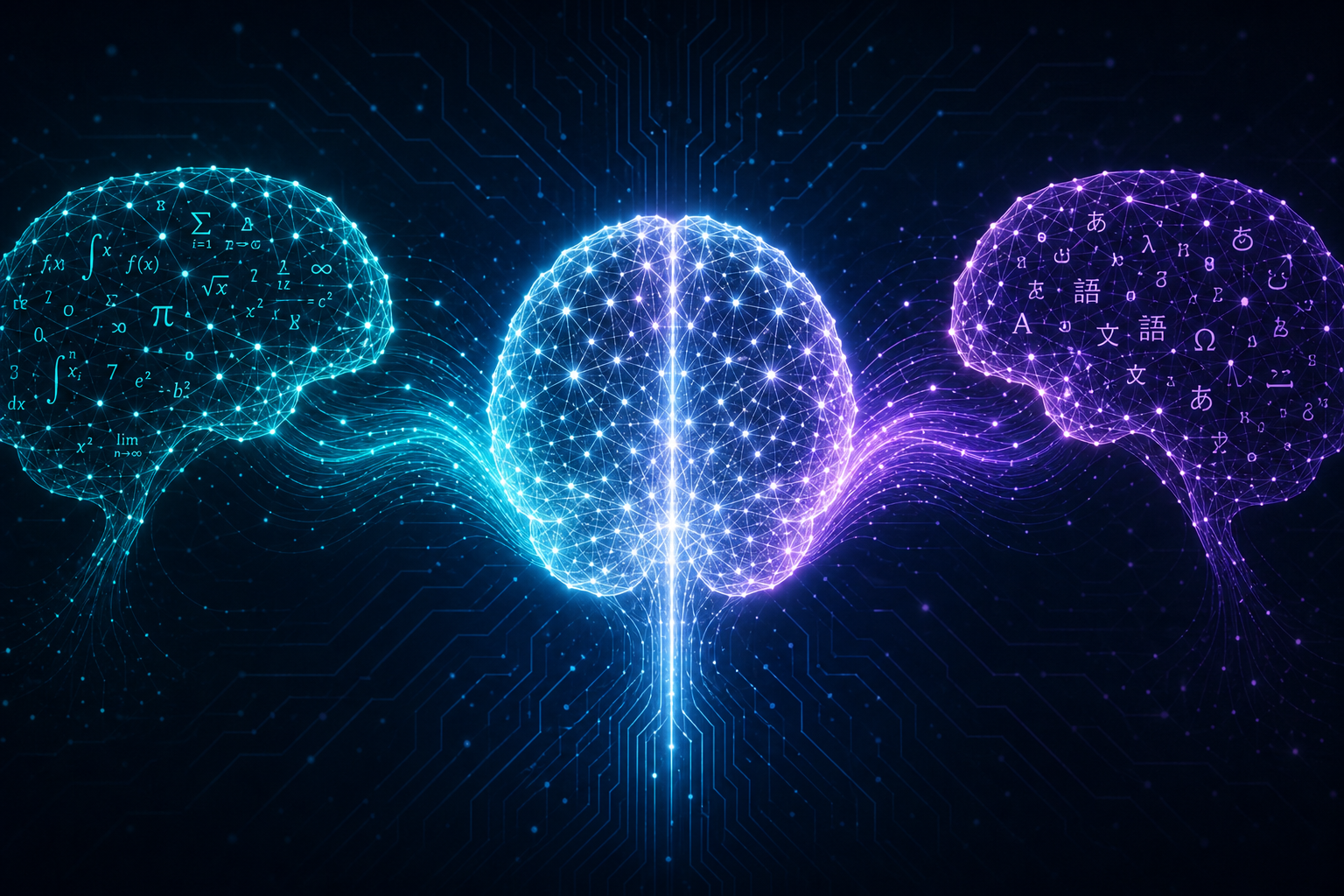
Imagine taking one model that is a genius at math and another that speaks perfect Japanese, then mashing them together to get a brilliant bilingual mathematician, without training a single new neural network. That is exactly the reality of LLM model fusion, and it is solving some of the biggest bottlenecks in AI.
To see why this matters, look at the old paradigm. Training a massive model from scratch costs millions of dollars in compute. Fine-tuning runs into catastrophic forgetting, where the model learns a new trick but forgets the general skills it already had. Ensembling (running multiple heavy models at once and combining their answers) works, but it hogs a huge amount of memory.
Now contrast that with model merging, a near zero-cost approach:
- No training data needed: You combine pre-trained models directly in parameter space, completely offline
- No GPU required: You can run a merge on a regular laptop
- One model at runtime: You end up running a single, highly capable model, not a memory-hungry ensemble
Unlike multitask learning (which forces you to dig up all the original private training data) or ensembling (which hogs memory at runtime), merging mathematically fuses model weights into one unified model. It is digital alchemy that actually works.
How Model Merging Works: Task Vectors and Task Arithmetic
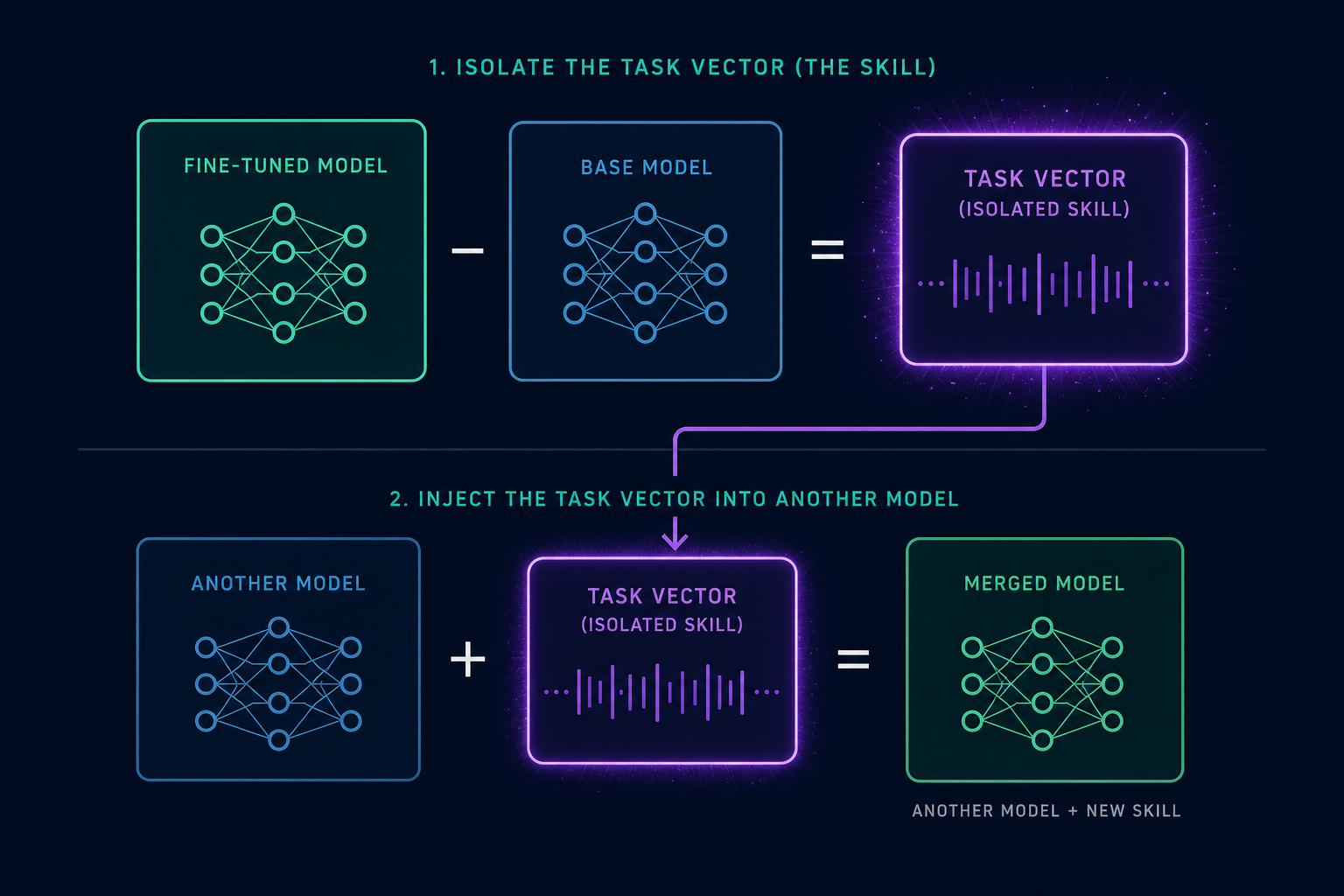
The secret sauce is the task vector. Subtract a base model's weights from a fine-tuned model's weights, and the math left over is the pure, concentrated essence of that new skill, ready to inject into another model of the same architecture. This is the core of task arithmetic.
The math ranges from simple to advanced:
- Linear mode connectivity: The simplest method, literally averaging the weights together (also called model soups)
- TIES merging: Resets tiny, insignificant changes to zero and resolves conflicts when one model wants a parameter positive and another wants it negative
- RegMean: Solves local linear regression problems to find the optimal merged weights
Why do you need these advanced methods? Because of sign interference. One model learned to turn a specific dial up, another learned to turn that exact dial down. If you just average them, they cancel to zero and the merged model forgets both skills. By resolving these sign conflicts before merging, you keep the high performance of both parent models.
OpenRouter Fusion: Real-Time API Model Fusion
Instead of merging weights offline, you can fuse models in real time at the API level. This is what OpenRouter Fusion does. You send your prompt to a panel of distinct models all at once. They answer in parallel, usually with web search enabled. Then a dedicated judge model steps in.
Crucially, the judge does not just smash their text together. It analyzes the answers for consensus, surfaces contradictions, spots blind spots none of the models addressed, then synthesizes everything into one highly reasoned answer.
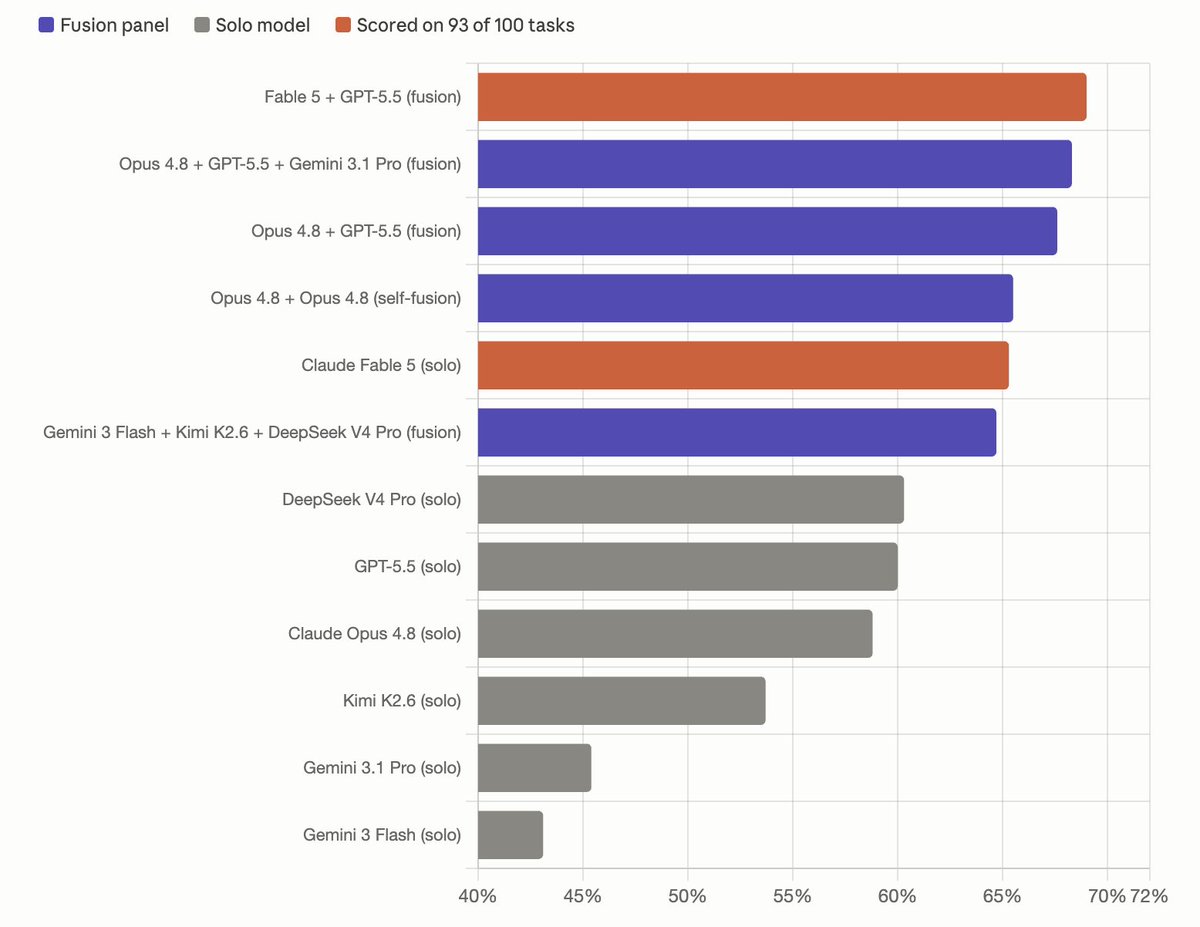
The takeaway is how powerful that synthesis is. As the benchmark above shows, a fused panel of smaller, budget models coordinated by a good judge routinely outperforms massive frontier models like GPT-5.5 or Claude Opus 4.8 on complex deep-research queries. By pooling multiple perspectives, fusion eliminates the blind spots you get from relying on any single monolithic model.
Franken-Merging and Evolutionary AI
Sakana AI called model merging "a form of alchemy that works." But here is where it gets wild: instead of humans guessing which models to combine, researchers let evolution do the heavy lifting, using automated algorithms inspired by natural selection to discover unintuitive new capabilities from the ocean of open-source models.
The results are staggering:
- Evolutionary model merge: Sakana AI's automated evolution discovered a recipe to merge models into a state-of-the-art Japanese math model, at just 7 billion parameters, beating 70 billion parameter models
- Franken-merging: Stacking layers from different models like Lego blocks to build new architectures, such as the Goliath 120B model
- Bias subtraction: Isolating a bias vector from a model trained on biased data and mathematically subtracting it, creating fairer AI without expensive retraining while keeping core reasoning intact
That last point is the most elegant: a mathematically precise, surgical extraction of unwanted behaviors using nothing but task arithmetic.
The Future Is Fused
We are moving well beyond the single brain. The open-source community now has the tools to mathematically fuse domain experts, continuously evolve new architectures, and run real-time API panels that beat the most expensive proprietary models on the market.
For small businesses, this is the underdog story that matters: you no longer need a frontier-model budget to get frontier-model results. Whether through offline merging or real-time fusion like OpenRouter Fusion, the smart play in 2026 is pooling capabilities, not paying for one giant model.
Resources
Want AI That Beats Frontier Models on a Small Budget?
Let TecAdRise Build Your Fused AI Stack
We help small businesses get frontier-level results without frontier-level bills, using model fusion, multi-model panels, and custom AI agents tuned to your workflows. Pool the right capabilities instead of overpaying for one giant model.
Get a Free Demo