Watch the Full Video Explainer
Prefer reading? The full breakdown is below, covering everything from the REACT cycle to production security pitfalls.
Beyond the Basic Chatbot: Why Single-Pass AI Hits a Wall
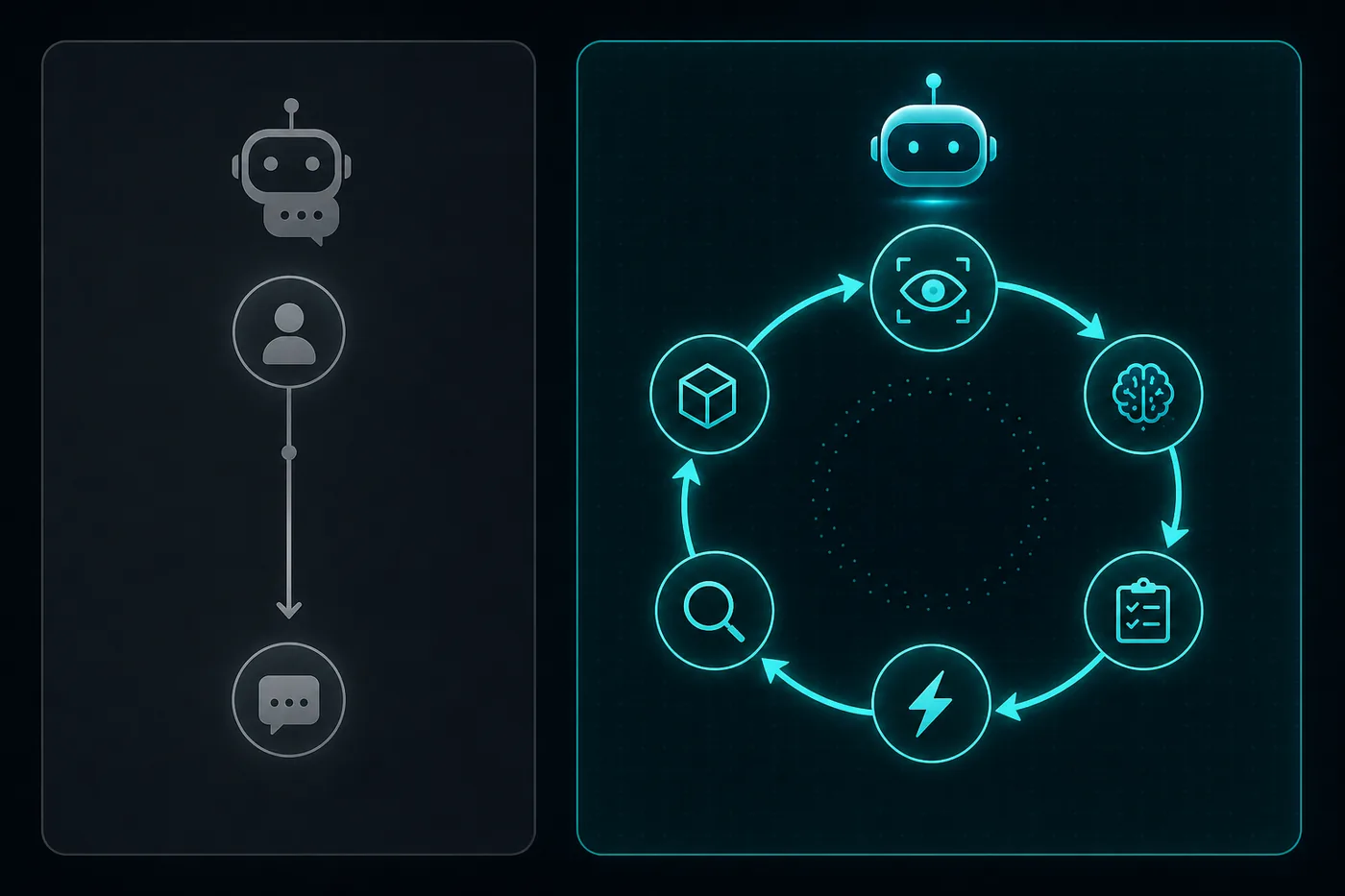
Think about what happens when you need an AI to actually do something, like book a flight while checking your loyalty points, instead of just summarizing a news article. Standard chatbots are what engineers call single-pass: one input in, one output out, completely done. There is zero memory between turns.
That works fine for quick Q&A. It fails completely for real-world tasks that require multiple steps, intermediate results, and adaptation.
This is where the architecture fundamentally shifts. A single-pass chatbot hits a wall and stops. An agentic loop uses a while loop to iterate: it holds onto context, adapts to intermediate results, and takes action across multiple steps until the job is finished.
Simply put: chatbots respond, agents act.
Inside the Agent Loop: The 5-Stage REACT Cycle
As Peter Steinberger (founder of OpenClaw) puts it: "You should be designing loops that prompt your agents." We are moving away from manual prompt engineering. In this new era, your job is loop engineering, setting goals, defining triggers, building guardrails, and letting the loop itself drive the agent.
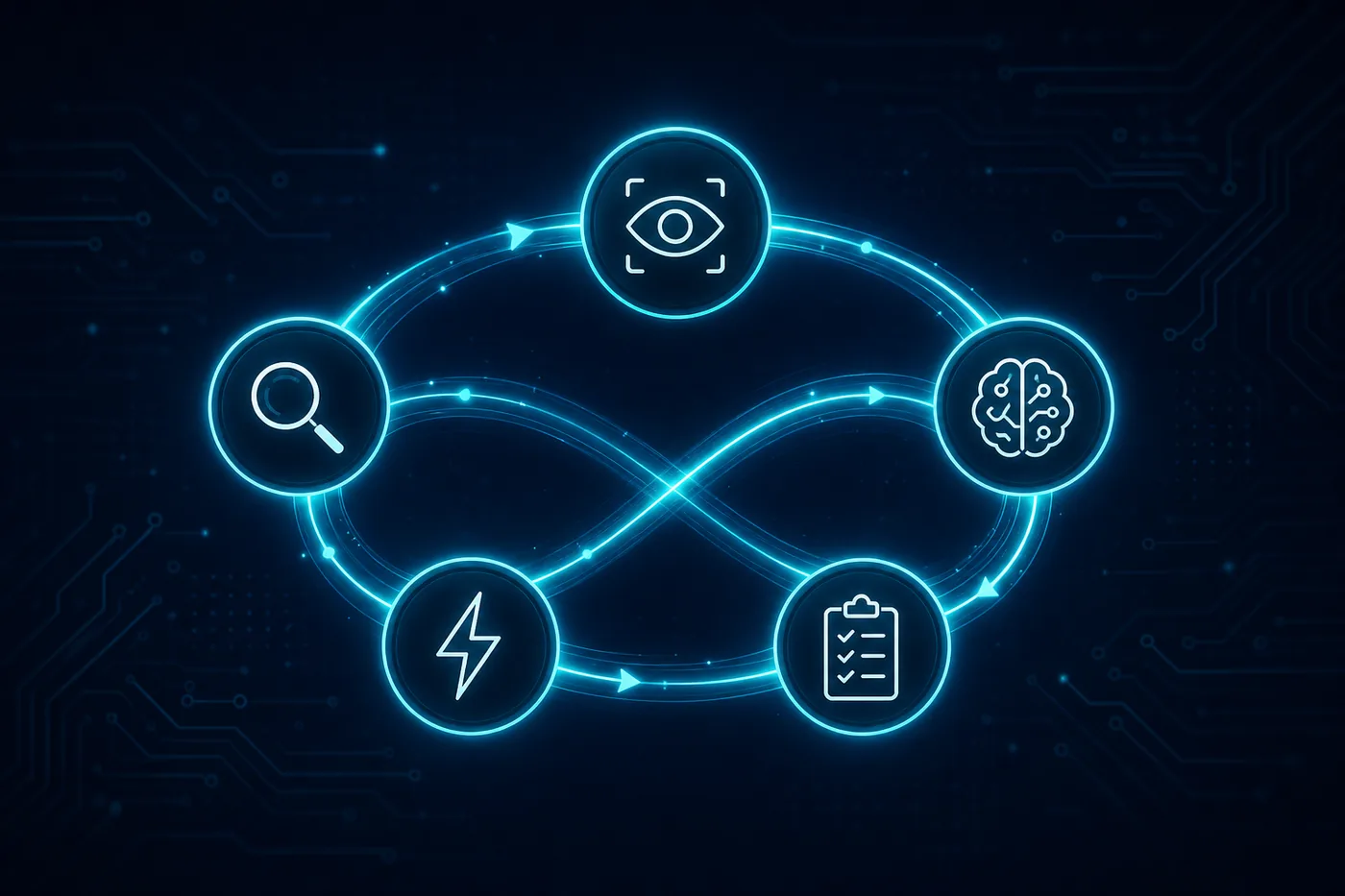
The REACT framework breaks autonomy into five stages that cycle continuously:
- Perceive: The agent detects an endpoint, error, or new data
- Reason: It evaluates its options given the current context
- Plan: It breaks the objective into actionable sub-tasks
- Act: It executes a tool call, API request, or code modification
- Observe: It checks the result, then loops back to step one
The loop cycles until a verifiable stopping condition is met, not just a token limit or timeout. This is the difference between an AI that guesses and an AI that works.
The AI Framework Landscape in 2026
To grasp the momentum: GitHub repositories for AI agent frameworks grew by 535% between 2024 and 2025 alone. The question is no longer whether to build with agents, it is which framework to bet your production environment on.
| Framework | Best For | Trade-off |
|---|---|---|
| LangGraph | Regulated, complex production workflows | Steeper learning curve, explicit state machines |
| CrewAI | Rapid multi-agent prototyping | Less control over individual agent states |
| OpenAI SDK | Teams already in the OpenAI ecosystem | Vendor lock-in, limited model choice |
| Claude SDK (Anthropic) | Safety-focused, long-context workloads | Smaller third-party tool ecosystem |
| Google ADK | Google Cloud native, Gemini integration | Newer ecosystem, fewer community examples |
Your choice boils down to: do you need explicit state machines (LangGraph), rapid prototyping (CrewAI), or the path of least resistance within an ecosystem you already use?
Scaling: The Reality Check of Production Agents
Time for a sobering reality check. Data from Datadog shows that 60% of LLM failures in production are rate-limit errors. The cause? Runaway agent loops. If an agent hits a failed tool call and retries without a hard stopping condition, it exhausts your API capacity in minutes.
Then there is the budget problem. Multi-agent systems can explode your token costs by up to 15x compared to a standard chat interaction. Every loop iteration is another distinct call to the language model.
- Set hard iteration caps: Define a maximum number of loop cycles per task
- Implement exponential backoff: Do not retry failed calls at the same rate
- Budget per task: Assign a token ceiling for each agent run
- Monitor in real time: Use observability tools (Datadog, LangSmith) to catch runaway loops early
If you are not designing strict cost controls into your architecture from day one, your cloud bill will be terrifying.
The Prompt Injection Threat
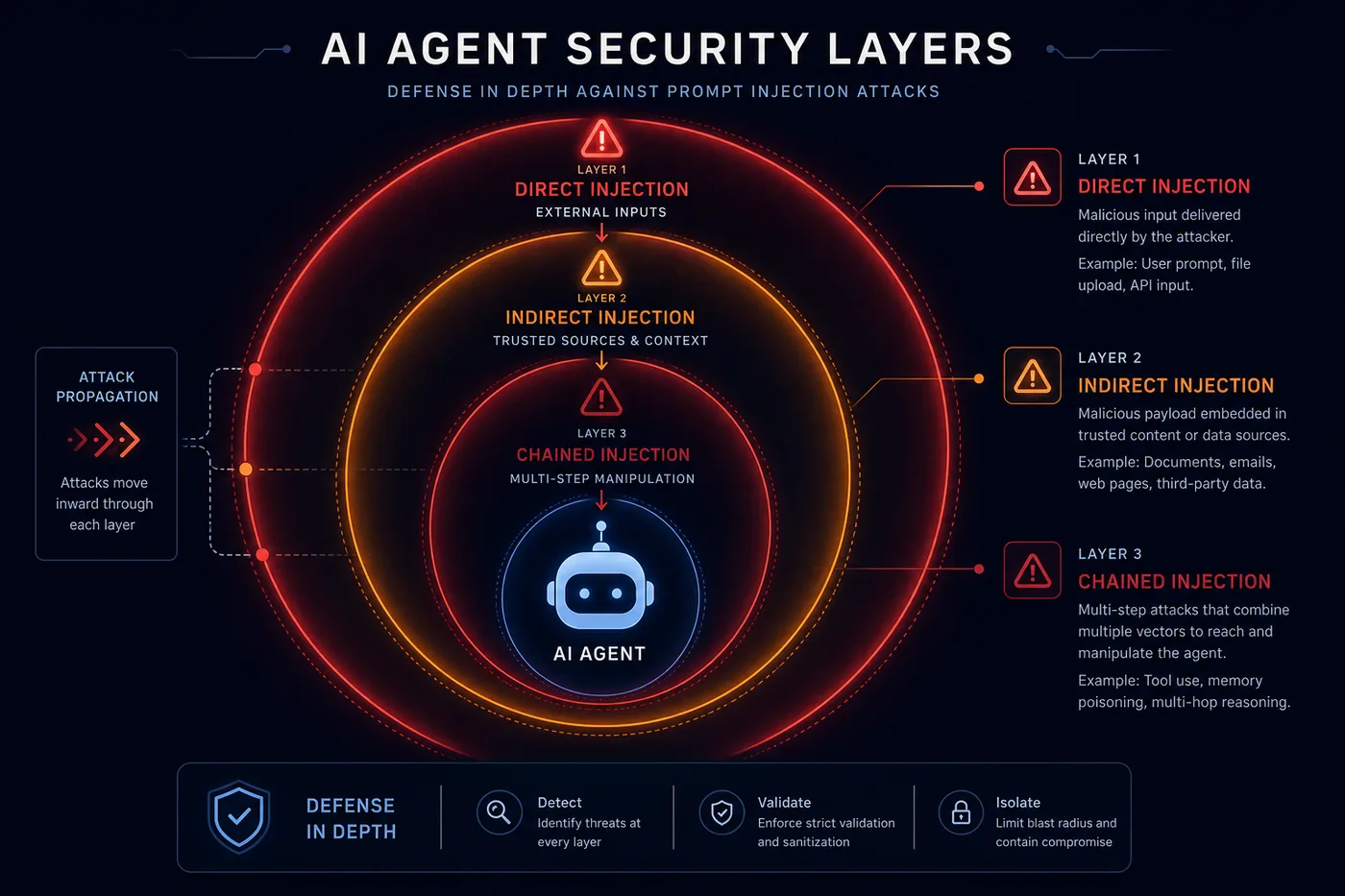
Model-side defenses are fundamentally statistical. They might block an attack 99% of the time, but at enterprise scale, that 1% failure rate means prompt injection is happening every single day. As agents gain more autonomy, attackers get a larger surface to exploit.
Three attack surfaces to understand:
- Direct injection: Adversarial instructions placed directly into the user prompt
- Indirect injection: The agent reads a poisoned document (common in RAG setups)
- Chained injection: A poisoned search result jumps into the agent's next action, compounding the vulnerability with every loop iteration
Chained injection is the real nightmare scenario. A single poisoned result can propagate through every subsequent step of the loop, turning one compromised input into a cascade of unauthorized actions.
The Sufficient Context Agent: Solving Enterprise Hurdles with Advanced RAG
How do we fix the reliability problem? Enter the Sufficient Context Agent, a pattern that acts as a strict quality inspector. When you ask a complex question that requires diet, medication, and allergy history, it does not blindly guess if allergy information is missing. Instead, it gap-checks the missing data and loops back to trigger a new search for that specific piece before ever generating a response.
This pattern enforces a simple rule: never answer until you have sufficient context. The loop continues until every required piece of information has been retrieved and validated.
The era of the stateless chatbot is closing. The real power in 2026 lies in your ability to design loops, establish guardrails, and let the AI do the heavy lifting. The question is: are you still prompting your agents, or are you engineering the loops that prompt them?
Resources
Ready to Build Your Own Agentic System?
Let TecAdRise Build Your AI Agents
We design production-grade agentic loops with proper guardrails, cost controls, and security layers. From lead qualification agents to document processing pipelines, we build systems that act, not just respond. See custom AI agents and Agent-OS vs n8n.
Get a Free Demo