Why AI Agents in Real Estate?
The real estate industry is experiencing a fundamental shift in how agents and brokerages interact with clients. In 2026, AI agents have moved from experimental technology to essential business tools that handle everything from initial inquiries to property recommendations. For real estate professionals, this transformation addresses several critical pain points that have long plagued the industry.
First, there is the challenge of response time. Studies consistently show that leads contacted within five minutes are significantly more likely to convert than those contacted after thirty minutes or more. Yet most agents cannot respond to every inquiry instantly, especially during evenings, weekends, or when showing properties. AI agents solve this by providing immediate, personalized responses at any hour.
Second, real estate involves repetitive yet important tasks: answering the same questions about listings, qualifying buyers, scheduling viewings, and following up with prospects. These tasks consume hours that agents could spend on high-value activities like negotiations and closings. AI agents handle this routine work efficiently, freeing human agents to focus on relationship building and complex transactions.
Third, the sheer volume of leads that modern brokerages generate through online portals, social media, and advertising often exceeds what human teams can effectively manage. Without proper qualification and nurturing, many potential clients fall through the cracks. AI agents can engage every single lead, qualify them based on criteria you define, and ensure no opportunity is missed.
Key Use Cases for AI in Real Estate
AI agents in real estate span a wide range of applications, each addressing specific challenges in the client journey. The most impactful use cases include:
- Instant lead response: Engaging website visitors and portal inquiries within seconds, capturing contact information and initial preferences.
- Lead qualification: Asking the right questions to determine budget, timeline, financing status, and property requirements.
- Property recommendations: Matching qualified buyers with suitable listings based on their criteria and behavior.
- Viewing scheduling: Coordinating calendars between agents and clients to book property tours.
- FAQ handling: Answering common questions about listings, neighborhoods, processes, and the agency itself.
- Follow-up nurturing: Maintaining contact with leads who are not yet ready to transact, keeping your agency top of mind.
- After-hours support: Ensuring clients can get answers and take action even when human agents are unavailable.
The best implementations combine multiple use cases into a cohesive system where AI handles initial engagement and routine tasks while seamlessly handing off to human agents for complex situations, negotiations, and relationship-critical moments.
Lead Qualification and Nurturing
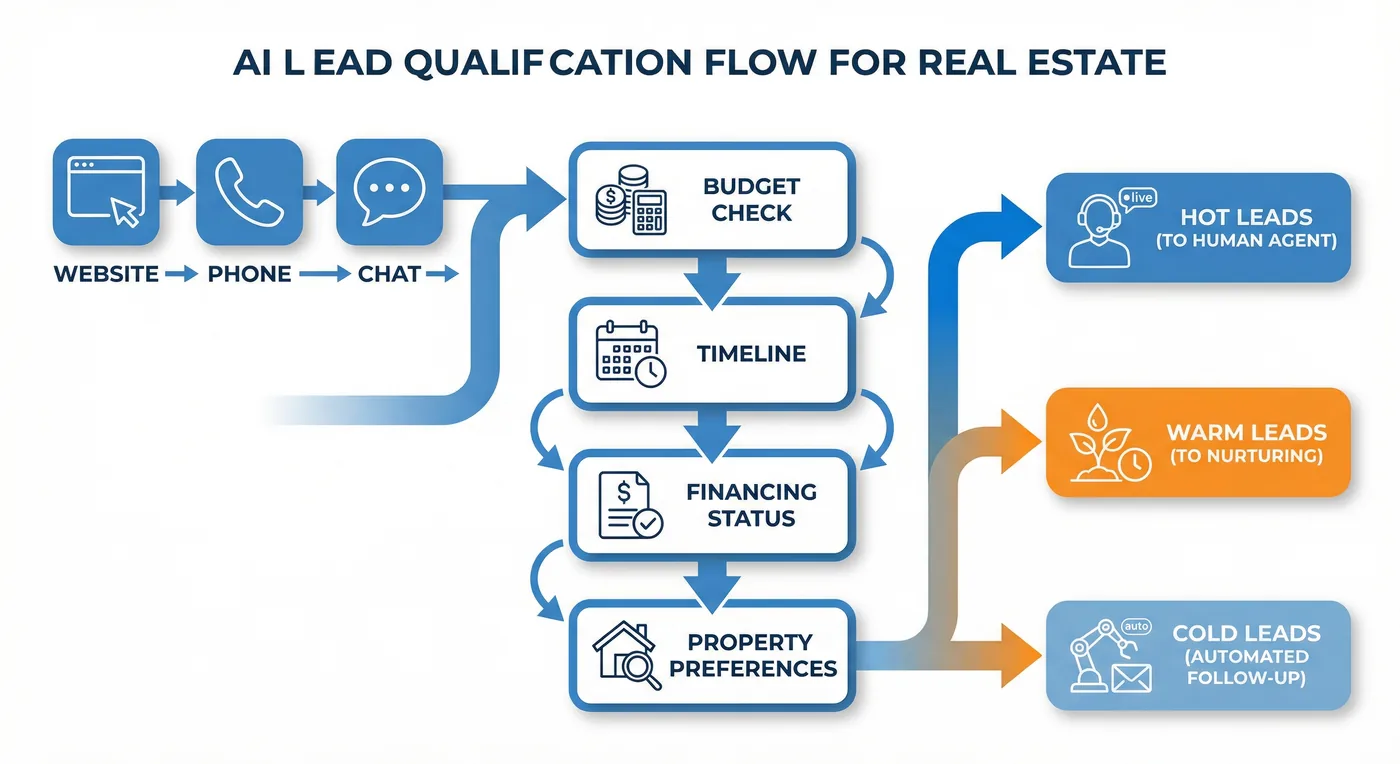
Lead qualification is perhaps the highest-ROI application of AI in real estate. Traditional approaches rely on agents manually calling or emailing every inquiry, a time-consuming process that often results in delayed responses and inconsistent follow-up. AI agents transform this by engaging leads instantly and systematically gathering the information agents need.
A well-configured AI qualification flow typically captures:
- Contact details: Name, phone, email, and preferred communication channel.
- Property type: House, apartment, commercial, land, or investment property.
- Location preferences: Specific neighborhoods, school districts, or commute requirements.
- Budget range: Price ceiling, down payment capacity, and whether financing is secured.
- Timeline: Urgency level, whether they are actively searching or just browsing.
- Current situation: First-time buyer, upsizing, downsizing, relocating, or investor.
Based on responses, the AI can score leads and route them appropriately. Hot leads with financing in place and immediate timelines get flagged for instant human follow-up. Warm leads enter nurturing sequences. Cold or unqualified inquiries receive helpful information without consuming agent time.
For nurturing, AI agents maintain ongoing engagement through scheduled check-ins, market updates, new listing alerts, and personalized content. This keeps your brokerage top of mind for leads who may not be ready to transact for months or even years, dramatically increasing the lifetime value of your lead database.
Intelligent Property Matching
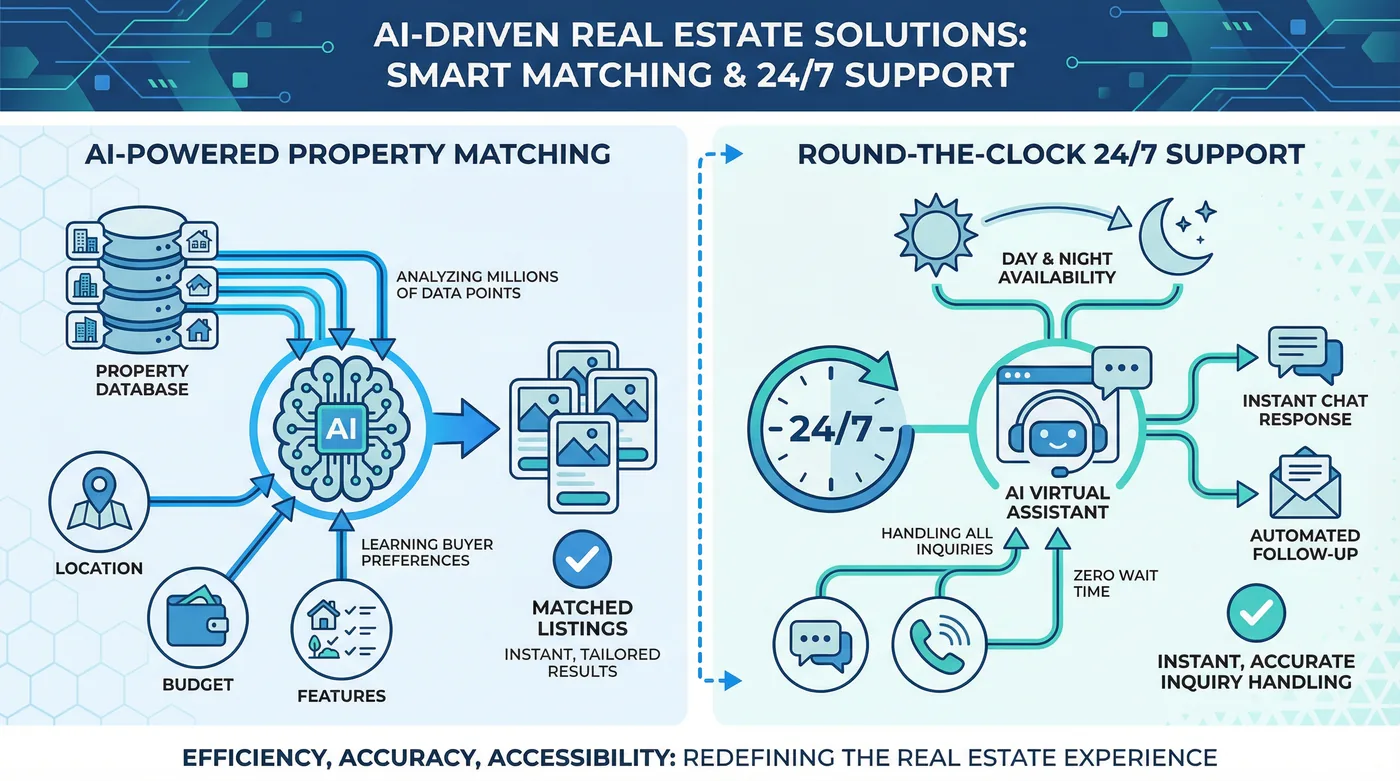
Beyond basic search filters, AI agents can provide intelligent property recommendations that consider both explicit criteria and implicit preferences. This goes far beyond traditional MLS searches to deliver a personalized experience that mirrors working with an experienced human agent.
Modern AI matching systems analyze:
- Stated preferences: Bedrooms, bathrooms, square footage, price, and location from qualification data.
- Behavioral signals: Which listings clients view, how long they spend on each, and what they save or share.
- Similar buyer patterns: What properties appealed to clients with similar profiles.
- Market dynamics: Price trends, days on market, and likelihood of properties meeting client criteria.
The AI can proactively reach out when new listings match a client's profile, when prices drop on properties they viewed, or when market conditions suggest it is time to act. This proactive engagement keeps clients engaged with your brokerage rather than searching elsewhere.
Integration with your MLS or property database is essential for this use case. Many platforms offer APIs that allow AI agents to query listings in real time, ensuring recommendations are always current and accurate.
Virtual Tours and Scheduling
Scheduling property viewings has traditionally been a logistical challenge involving back-and-forth communication, calendar coordination, and manual confirmation. AI agents streamline this process by handling scheduling conversations, checking availability, and confirming appointments automatically.
A typical AI scheduling flow works as follows:
- Client expresses interest in viewing a property through chat, voice, or web form.
- AI confirms the property is available for viewing and asks for preferred dates and times.
- AI checks the assigned agent's calendar for availability and offers options.
- Client selects a slot; AI creates the appointment and sends confirmations to both parties.
- AI sends reminders before the viewing and follows up afterward for feedback.
For virtual tours, AI agents can guide clients through pre-recorded video tours or interactive 3D walkthroughs, answering questions in real time. This is particularly valuable for out-of-town buyers, investors, or clients doing initial screening before committing to in-person visits.
Calendar integration with tools like Google Calendar, Outlook, or specialized real estate CRMs ensures double-booking is avoided and agents always have accurate schedules.
24/7 Client Support
Real estate clients often have questions outside business hours. They browse listings in the evening, research neighborhoods on weekends, and may be in different time zones altogether. An AI agent ensures these clients receive immediate assistance regardless of when they reach out.
Common after-hours scenarios AI agents handle effectively:
- Listing inquiries: Providing details, photos, and information about specific properties.
- Neighborhood questions: Schools, amenities, commute times, and local market trends.
- Process guidance: Explaining buying or selling steps, required documents, and timelines.
- Urgent requests: Capturing details and scheduling callbacks for time-sensitive matters.
- Appointment booking: Allowing clients to schedule viewings even at midnight for the next available slot.
The key to effective 24/7 support is a comprehensive knowledge base that covers your listings, your market, and your processes. The AI agent draws on this knowledge to answer questions accurately while knowing when to escalate to a human agent for complex or sensitive matters.
Implementation Strategy
Successfully deploying AI agents in real estate requires thoughtful planning and phased implementation. Here is a practical roadmap:
Phase 1: Foundation (Weeks 1-2)
- Define primary use cases based on your biggest pain points (usually lead response and qualification).
- Document your qualification criteria, common questions, and ideal client profiles.
- Select an AI platform that integrates with your existing CRM and communication channels.
- Build your initial knowledge base with listing information, FAQs, and process documentation.
Phase 2: Pilot (Weeks 3-4)
- Deploy AI on a single channel (website chat or dedicated phone line).
- Route a portion of leads through the AI while maintaining human backup.
- Monitor conversations, gather feedback, and refine responses.
- Train your team on working alongside AI and handling escalations.
Phase 3: Expansion (Weeks 5-8)
- Extend AI to additional channels (SMS, voice, portal integrations).
- Add property matching and proactive outreach capabilities.
- Integrate scheduling with agent calendars.
- Implement lead scoring and automated routing rules.
Phase 4: Optimization (Ongoing)
- Analyze conversion rates and adjust qualification criteria.
- Expand knowledge base based on new questions and listings.
- Test different conversation flows and messaging.
- Scale to additional teams or offices.
ROI and Metrics
Measuring the return on investment for AI agents in real estate involves tracking both efficiency gains and revenue impact. Key metrics to monitor include:
- Response time: Average time from inquiry to first response (target: under one minute).
- Lead capture rate: Percentage of website visitors who provide contact information.
- Qualification rate: Percentage of leads successfully qualified by AI.
- Appointment booking rate: Leads who schedule viewings through AI.
- Agent time saved: Hours per week reclaimed from routine tasks.
- Lead-to-client conversion: Overall conversion rate compared to pre-AI baseline.
- Client satisfaction: Feedback scores from clients who interacted with AI.
Most real estate businesses see positive ROI within three to six months of implementation. The combination of faster response times, higher engagement rates, and agent time savings typically far exceeds the cost of AI platforms.
For a brokerage handling 500 leads per month, even modest improvements in conversion rates translate to significant additional closings per year. When you factor in the time agents save on qualification calls and scheduling, the business case becomes compelling.
Conclusion
AI agents are transforming real estate from an industry constrained by agent availability and manual processes to one where every lead receives immediate, personalized attention at any hour. The technology has matured to the point where implementation is straightforward and ROI is measurable within months.
The key to success is starting with clear use cases, building a comprehensive knowledge base, and treating AI as a team member that enhances rather than replaces human agents. The brokerages winning in 2026 are those that combine AI efficiency with human expertise, delivering superior client experiences while scaling their operations.
At TecAdRise, we specialize in designing and deploying AI agents for real estate professionals. From lead qualification and property matching to 24/7 client support, we help you implement solutions that drive measurable results. See our custom AI agents and AI voice agents pages for pricing, demos, and typical brokerage workflows.
Resources
Ready to Transform Your Real Estate Business?
Contact TecAdRise for a consultation on AI agents tailored to your brokerage. We will help you capture more leads, qualify faster, and close more deals.
Get Started