The Problem: AI Has Amnesia
Every time you start a new conversation with an AI assistant, it starts completely blank. It does not know who you are, what you worked on yesterday, or what decisions your team made last week. This is not a quirk of a specific product, it is a fundamental architectural limitation of how large language models work today.
The typical workarounds developers reach for all have ceilings:
- Vector DB with RAG: Passive retrieval. You embed once, retrieve later. The system never actively processes or connects what it has learned.
- Conversation summaries: Loses detail over time. No cross-referencing between sessions. One long project collapses into a paragraph.
- Knowledge graphs: Highly accurate but expensive to build, maintain, and query at scale.
None of these approaches mimic the way a human brain handles memory. During sleep, the human brain does not just store memories, it replays, connects, and compresses information from the day. It builds associations between seemingly unrelated facts. That is exactly what the Always-On Memory Agent is designed to do.
What Is the Always-On Memory Agent?
The Always-On Memory Agent is an open-source project from Google Cloud Platform built on Google ADK (Agent Development Kit) and Gemini Flash-Lite. It runs as a lightweight background process 24/7, continuously ingesting information, finding connections between memories, and making that knowledge available on demand, without a vector database or embedding pipeline.
The entire memory store is just SQLite. No infrastructure to provision, no embedding model to host. A single LLM reads, thinks, and writes structured memories.
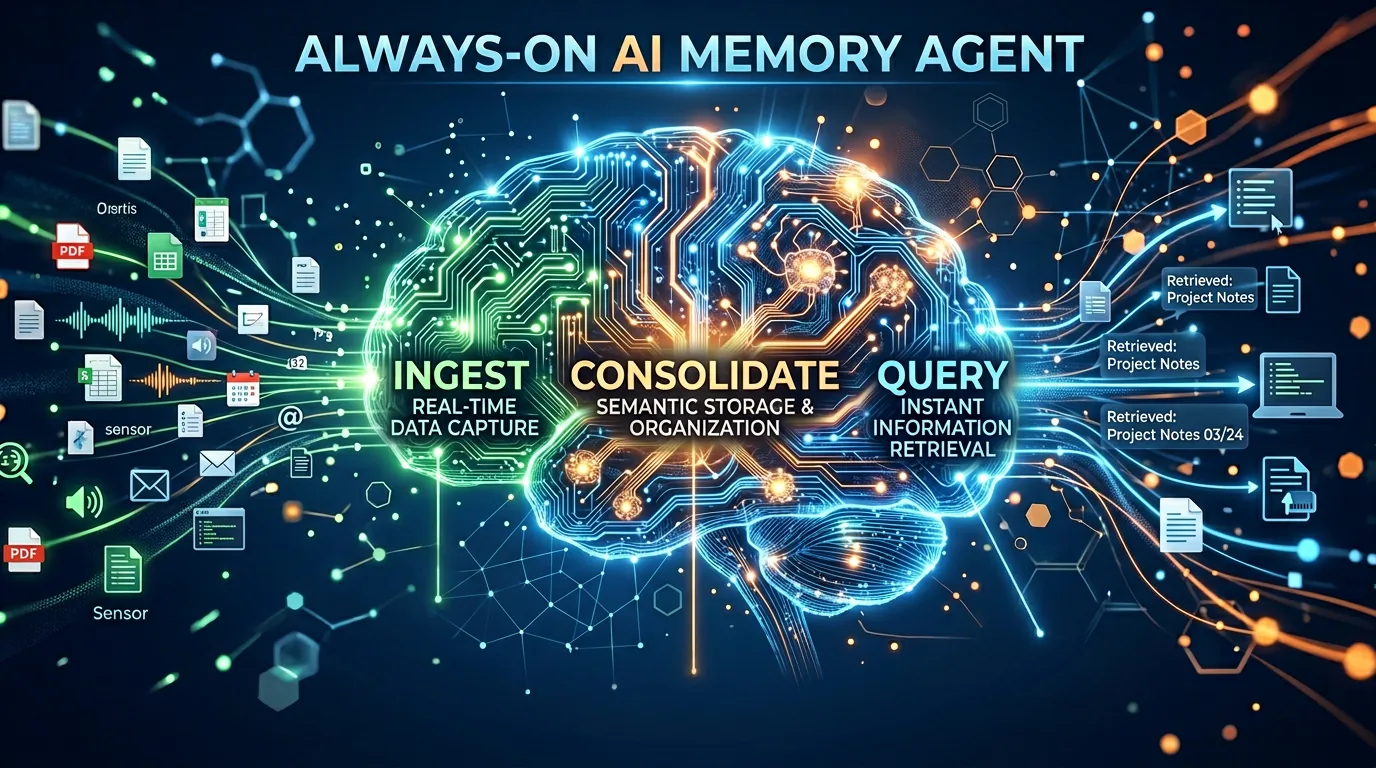
It supports 27 file types across text, images, audio, video, and PDFs. You drop a file into an inbox folder, and the agent processes it automatically within seconds. You can also push content via a REST API or the built-in Streamlit dashboard.
Architecture: Three Specialist Agents
The system uses an orchestrator pattern with three specialist agents, each with dedicated tools for reading and writing the memory store:
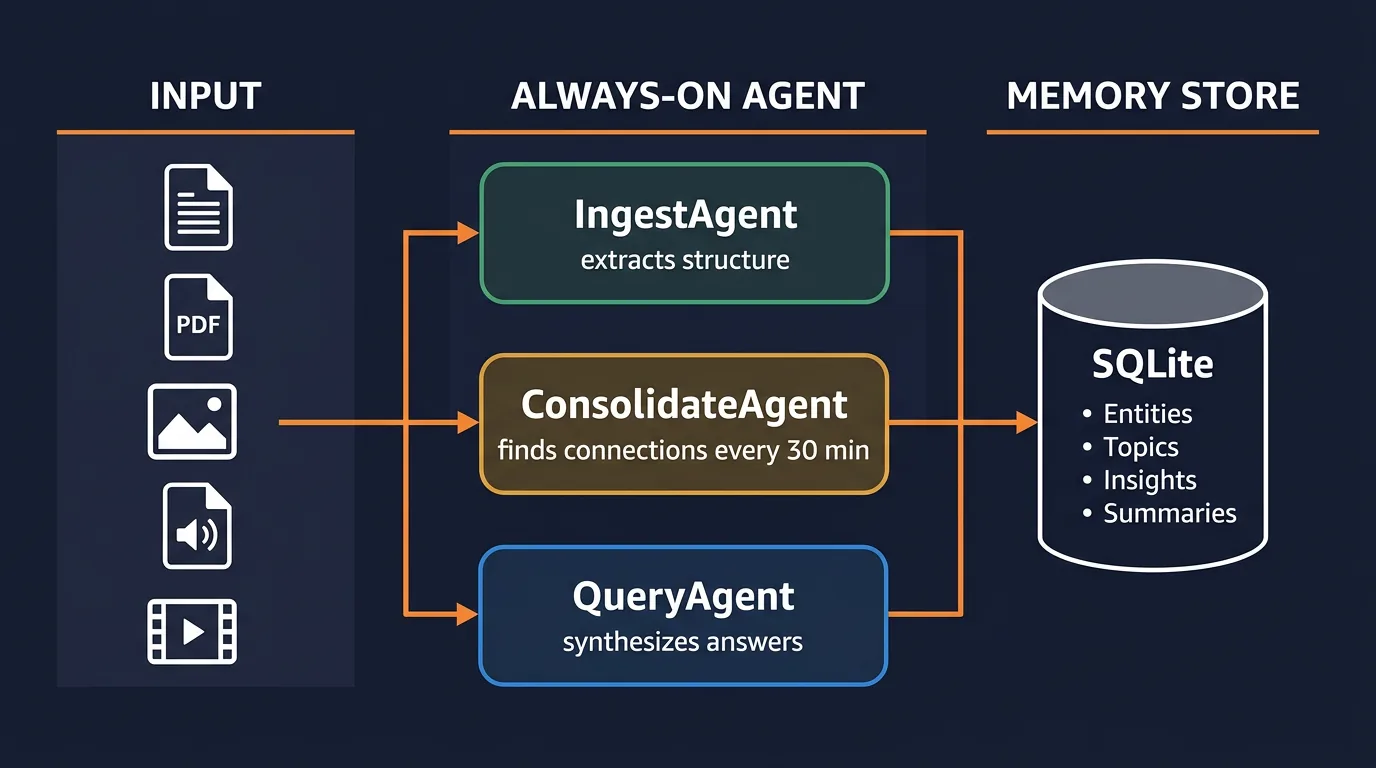
- IngestAgent: Receives any file or text input. Uses Gemini's multimodal capabilities to extract a structured summary, named entities, topics, and an importance score. Writes the result to SQLite as a new memory record.
- ConsolidateAgent: Runs on a configurable timer (default every 30 minutes). Reviews all unconsolidated memories, finds cross-cutting connections, generates new insights from patterns, and compresses related information, mimicking the brain's nightly consolidation cycle.
- QueryAgent: Handles user questions. Reads all stored memories and consolidation insights, then synthesizes a grounded answer with source citations pointing back to specific memory records.
Each agent operates independently on its own schedule, meaning the system continuously learns in the background even when nobody is actively using it.
How It Works: Ingest, Consolidate, Query
Step 1: Ingest
Feed the agent anything. Drop a PDF meeting summary in the inbox folder, POST raw text from your application, or upload a file through the dashboard. The IngestAgent uses Gemini to extract structure from the content:
Input: "Anthropic reports 62% of Claude usage is code-related.
        AI agents are the fastest growing category."
           │
           ▼
   Summary:  Anthropic reports 62% of Claude usage...
   Entities: [Anthropic, Claude, AI agents]
   Topics:   [AI, code generation, agents]
   Importance: 0.8
The importance score lets the system prioritize what to keep, reference, and surface during queries.
Step 2: Consolidate
Every 30 minutes, the ConsolidateAgent wakes up and reviews memories that have not yet been connected to other memories. It looks for patterns, contradictions, and complementary facts across the entire knowledge base:
Memory #1: "AI agents are growing fast but reliability is a challenge"
Memory #3: "Current LLM memory approaches all have gaps"
                   │
                   ▼  ConsolidateAgent
   Insight: "The bottleneck for next-gen AI tools is the
             transition from static RAG to dynamic memory"
These generated insights become first-class memory records themselves, creating an ever-growing web of connected knowledge.
Step 3: Query
Ask any question in natural language. The QueryAgent reads all stored memories and consolidation insights, then synthesizes a structured answer with citations back to specific memory records. You always know exactly which source an answer came from.
Quick Start: Running It Yourself
The project is straightforward to run locally. You need Python, a Google AI Studio API key, and about 5 minutes:
git clone https://github.com/GoogleCloudPlatform/generative-ai
cd generative-ai/gemini/agents/always-on-memory-agent
pip install -r requirements.txt
export GOOGLE_API_KEY="your-gemini-api-key"
python agent.py
Once running, the agent watches ./inbox/ for files and serves queries at http://localhost:8888. Three ways to feed it information:
- File watcher: Drop any supported file in
./inbox/and the agent auto-ingests within 5 to 10 seconds. - HTTP API: POST to
/ingestwith JSON containing your text and source label. - Dashboard: Run
streamlit run dashboard.pyfor a visual interface with upload, query, browse, and manual consolidation buttons.
The full API surface is minimal and clean:
GET  /status       Memory statistics (counts)
GET  /memories     List all stored memories
POST /ingest       Add new text memory
GET  /query?q=...  Ask a question
POST /consolidate  Trigger manual consolidation
POST /delete       Delete a memory by ID
POST /clear        Full reset
You can also adjust the consolidation interval with --consolidate-every MIN and change the watched inbox folder with --watch DIR.
Why This Changes AI Automation in 2026
Most AI agents in production today are stateless. Each workflow run starts from scratch. Every RAG pipeline is read-only. The agent answers your question and forgets it ever happened.
The Always-On Memory Agent breaks this pattern in a few important ways:
- Active, not passive: The agent continuously processes information in the background, not only when a user triggers it. Knowledge compounds over time without manual curation.
- No embeddings required: The entire retrieval mechanism is the LLM itself reading structured memory records. This eliminates the embedding model, the vector index, and the chunking pipeline as dependencies.
- Cross-modal memory: Text, images, audio, and video are all processed into the same unified memory store. A meeting recording and a PDF report land in the same knowledge base and can be connected by the ConsolidateAgent.
- Cost-effective at scale: Using Gemini Flash-Lite for all background operations keeps the per-session cost negligible, making true 24/7 operation practical even for small teams.
For businesses building AI automation workflows with tools like n8n, this pattern opens up a new category of agent: one that remembers every customer interaction, every support ticket resolution, every product decision, and surfaces relevant context automatically the next time a related question comes in.
At TecAdRise, we are already exploring how this memory architecture integrates with AI voice agents. Imagine a voice agent that remembers a caller's previous issues, preferences, and the outcome of their last three calls, without any human having to brief it. That is where AI automation is heading in 2026.
Watch the Full Breakdown
We covered the Always-On Memory Agent architecture in full on our YouTube channel. Watch below for a visual walkthrough of how IngestAgent, ConsolidateAgent, and QueryAgent work together to give your AI persistent memory:
Conclusion
The Always-On Memory Agent is a practical, deployable demonstration of what persistent AI memory looks like without the complexity of a full vector database stack. By combining Google ADK's orchestration capabilities with Gemini's multimodal understanding, it creates a lightweight system that ingests, consolidates, and retrieves knowledge continuously, much like human long-term memory formation during sleep.
Whether you are building customer-facing AI agents, internal knowledge management tools, or automating complex multi-step workflows, persistent memory is the next architectural primitive you need to understand. The gap between stateless AI tools and truly adaptive agents is closing fast, and the Always-On Memory Agent shows one compelling path forward.
Resources
Ready to Build AI Agents That Actually Remember?
TecAdRise specializes in AI automation, voice agents, and RAG systems for businesses ready to move beyond stateless AI. Let us help you build something that learns.
Get Started