What Is OpenRAG?
Building a production-grade RAG pipeline from scratch in 2026 still takes weeks. You need a document parser that handles messy real-world formats, a vector store or search backend that scales, an orchestration layer that manages retrieval workflows, and a frontend your team can actually use. Then you need to wire all of it together and keep it running.
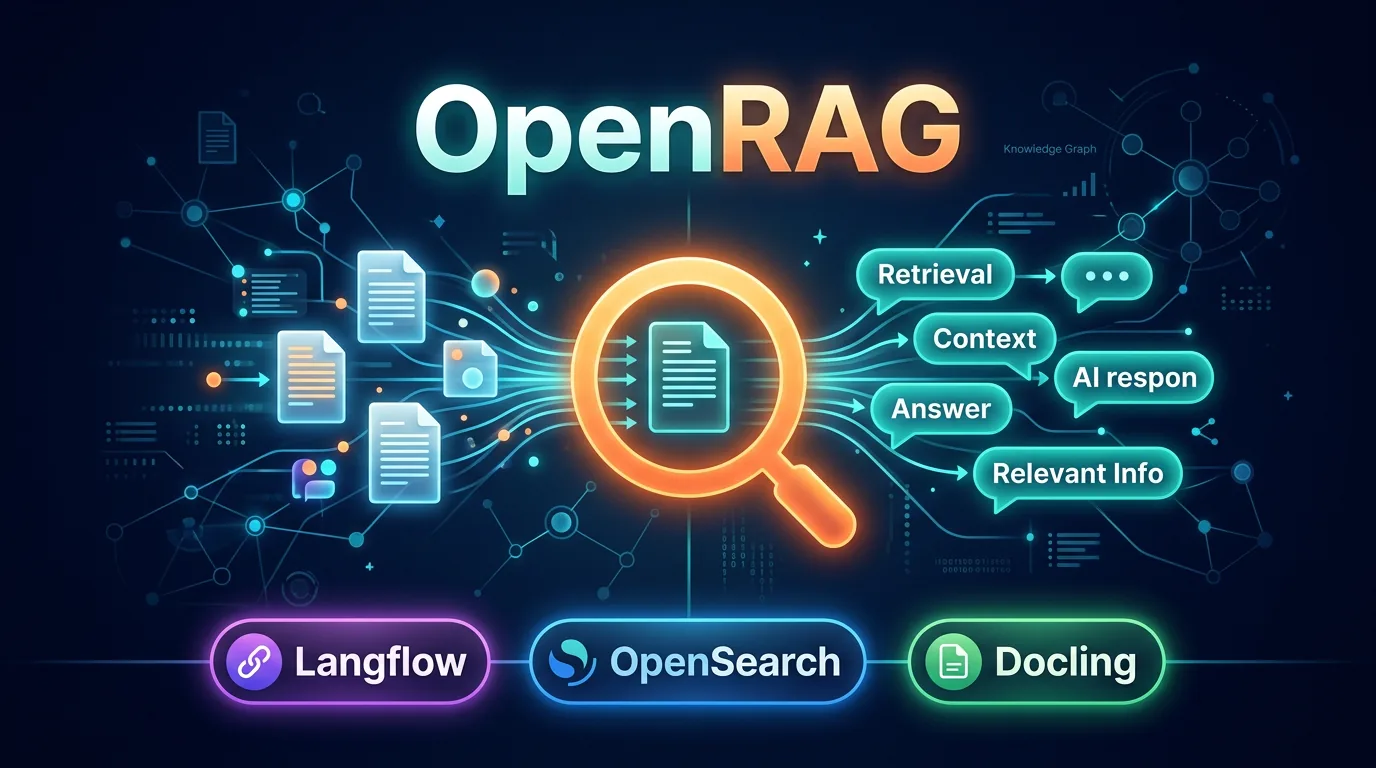
OpenRAG collapses that entire stack into one deployable package. It is an open-source Retrieval-Augmented Generation platform built on three best-in-class components: Langflow for agentic workflow orchestration, OpenSearch for production-grade semantic search, and Docling for intelligent document parsing. The result is a platform that goes from zero to a fully functional AI document search system with a single install command.
At the time of writing, OpenRAG has nearly 1,000 GitHub stars and 95 forks, with 51 releases including a 0.3.0 milestone shipped in March 2026. It is actively maintained by the Langflow team and available under the Apache 2.0 license.
The Stack: Langflow, OpenSearch, Docling
Understanding why OpenRAG works requires understanding what each of its three core components brings to the table:
- Langflow: A visual, drag-and-drop workflow builder for AI pipelines. In OpenRAG, Langflow handles the agentic orchestration layer, managing document ingestion flows, retrieval logic, re-ranking, and multi-agent coordination. You can inspect and modify workflows visually without touching the underlying Python.
- OpenSearch: The production-grade search backend that powers the semantic index. OpenSearch handles vector search at scale, keyword search, hybrid queries, and re-ranking. It is the same technology that powers enterprise search at companies processing billions of documents.
- Docling: IBM's open-source document parsing library that handles messy, real-world input. PDFs with complex layouts, tables, figures, and mixed formatting all get intelligently parsed into clean, structured text before being indexed. This is the piece most home-built RAG systems get wrong.
The frontend is built with Next.js and the backend with Starlette. Everything ships together via Docker Compose, making deployment a single command rather than a multi-day infrastructure project.
Key Features
- Pre-packaged and ready to run: All core tools are connected out of the box. No manual wiring between components, no separate vector store setup, no custom chunking code to write.
- Agentic RAG workflows: Advanced orchestration with re-ranking and multi-agent coordination built in. The system does not just retrieve and generate, it reasons about retrieval quality and can coordinate across multiple sources.
- Intelligent document ingestion: Docling handles the edge cases that break most RAG pipelines. Tables, headers, footnotes, multi-column PDFs, and mixed-format documents all get parsed correctly.
- Visual workflow builder: Non-engineers on your team can inspect and modify the retrieval logic through Langflow's drag-and-drop interface, without code.
- Enterprise scale: OpenSearch is not a toy vector store. It is production-grade infrastructure used by enterprises processing millions of documents daily.
- Modular add-ons: Security configuration, Kubernetes Helm charts, and GPU support are all included for teams that need them.
How OpenRAG Works
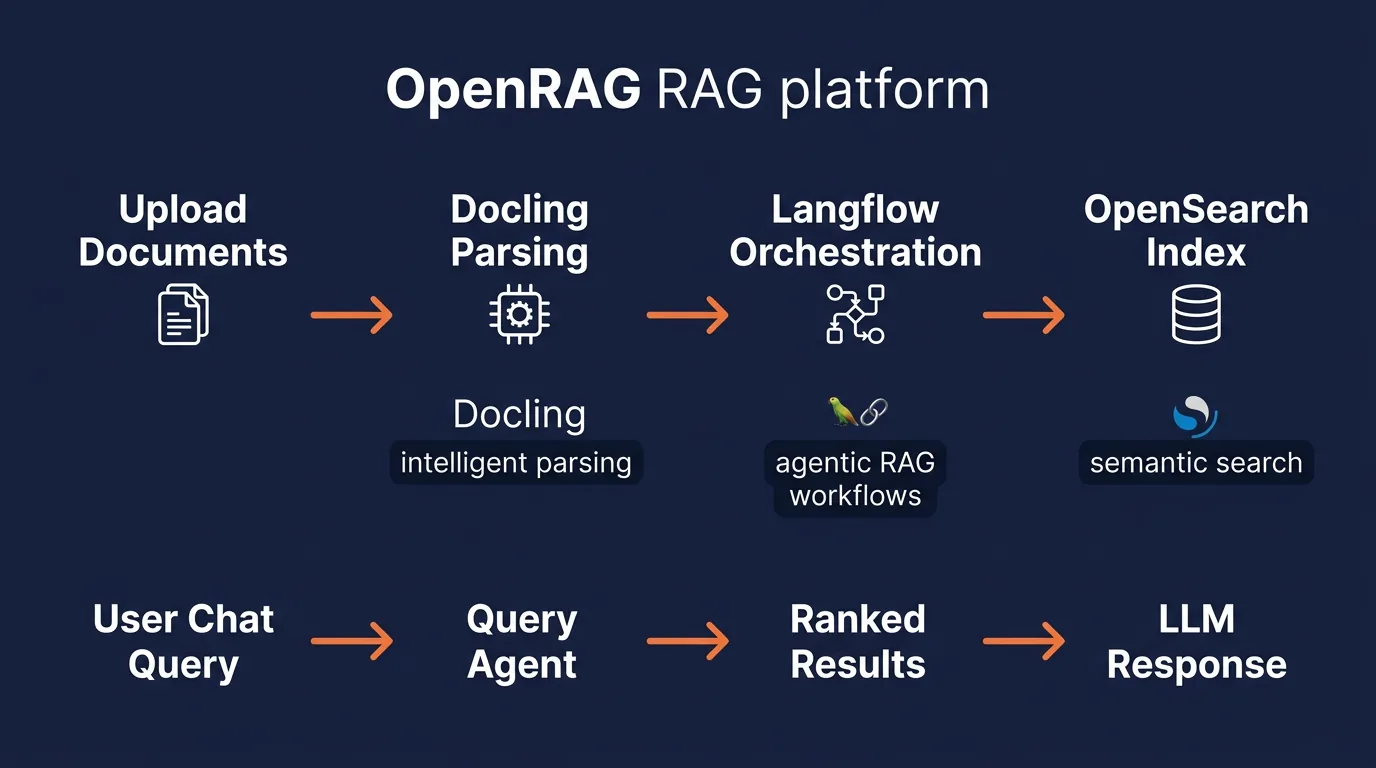
The workflow follows a clean, four-stage pipeline. Users upload documents through the web interface or API. Docling parses them into structured text, preserving tables, lists, and section hierarchy that naive parsers would destroy. Langflow orchestrates the ingestion flow, chunking and embedding the parsed content. OpenSearch indexes the embeddings and text for fast semantic retrieval.
When a user asks a question through the chat interface, the query goes to an agent that performs semantic search against the OpenSearch index, retrieves the most relevant passages, re-ranks them, and passes the ranked context to an LLM for answer generation. The entire chain is visible and editable through Langflow.
Three ways to interact with the system:
- Web interface: Upload documents via drag and drop, ask questions in the chat UI, and see answers with source citations linking back to the original documents.
- REST API: Every operation is available as an API endpoint, making OpenRAG embeddable in any application.
- SDKs: Official Python and TypeScript SDKs wrap the API for clean programmatic access.
Quick Start and SDKs
Getting OpenRAG running locally requires Docker and one command:
git clone https://github.com/langflow-ai/openrag
cd openrag
docker-compose up
Once running, navigate to the web interface, upload your documents, and start chatting with your knowledge base. The Python SDK is equally minimal:
pip install openrag-sdk

import asyncio
from openrag_sdk import OpenRAGClient

async def main():
    async with OpenRAGClient() as client:
        response = await client.chat.create(
            message="What is our refund policy?"
        )
        print(response.response)

asyncio.run(main())
The TypeScript SDK follows the same pattern, making it straightforward to embed OpenRAG into a Next.js or Node.js application:
npm install openrag-sdk

import { OpenRAGClient } from "openrag-sdk";
const client = new OpenRAGClient();
const response = await client.chat.create({
    message: "Summarize the Q4 report"
});
console.log(response.response);
MCP Integration
One of the most forward-looking features of OpenRAG is its Model Context Protocol (MCP) server. MCP is the emerging standard for connecting AI assistants like Cursor and Claude Desktop to external tools and data sources. OpenRAG ships with a ready-made MCP server that exposes your document knowledge base to any MCP-compatible AI assistant:
pip install openrag-mcp

// Cursor / Claude Desktop config:
{
  "mcpServers": {
    "openrag": {
      "command": "uvx",
      "args": ["openrag-mcp"],
      "env": {
        "OPENRAG_URL": "http://localhost:3000",
        "OPENRAG_API_KEY": "your_api_key_here"
      }
    }
  }
}
With this configuration, a developer using Cursor can ask questions against the company knowledge base directly from their IDE, and Claude Desktop users can query internal documents without leaving their workflow. The MCP server provides tools for RAG-enhanced chat, semantic search, and settings management.
This is a significant integration point for businesses already using AI coding assistants or AI desktop tools across their teams.
Why OpenRAG vs Building RAG Yourself
The honest answer is that building a robust RAG pipeline from scratch is harder than it looks. The first prototype usually takes a few days. Making it production-ready takes months, because the problems only appear at scale: documents with unusual formatting that the parser chokes on, retrieval quality that degrades as the index grows, latency issues under load, and security gaps in multi-user deployments.
OpenRAG solves the problems that raw LangChain tutorials skip over:
- Document quality: Docling handles the edge cases. Most naive RAG implementations lose critical information from tables, headers, and complex layouts. Docling preserves structure.
- Search quality: OpenSearch's re-ranking capabilities produce meaningfully better retrieval than naive cosine similarity on a small vector store. This directly translates to better answers.
- Observability: Langflow gives you a visual view of every step in the pipeline. When retrieval fails, you can see why without instrumenting the code yourself.
- Deployment: Kubernetes Helm charts, Docker Compose files, GPU support, and security configuration are all included. You are not starting from scratch for each deployment environment.
For teams at TecAdRise building AI automation systems for businesses, OpenRAG represents a compelling foundation for internal knowledge base applications, customer-facing document Q&A, and any workflow that requires grounding an LLM in a specific corpus of documents.
Watch the Full Breakdown
We covered the full OpenRAG platform on our YouTube channel. Watch below for a visual walkthrough of the stack, the 4-stage pipeline, SDK examples, and MCP integration:
Conclusion
OpenRAG is one of the most complete open-source RAG platforms available in 2026. By combining Langflow's visual orchestration, OpenSearch's enterprise-grade search, and Docling's intelligent parsing, it delivers a production-ready document intelligence system that would take months to assemble from individual components.
Whether you are building an internal knowledge base for your team, a customer-facing document Q&A system, or integrating document search into an existing AI agent, OpenRAG gives you a robust, observable, and scalable foundation to build on. The MCP integration in particular makes it immediately useful for any team already working with AI coding assistants or Claude Desktop.
Resources
Ready to Deploy a RAG System for Your Business?
TecAdRise specializes in building and deploying AI automation systems including RAG pipelines, voice agents, and intelligent document workflows. Let us help you get from zero to production.
Get Started