![Vibe Coding vs Spec-Driven Development [Side-by-Side]](/images/blog/vibe-vs-spec-coding-hero.webp)
The Way Apps Get Built Is Changing
Before AI coding tools, writing and reviewing code was the hardest part of building software. You needed years of experience, deep knowledge of frameworks, and a lot of patience for debugging. That barrier is collapsing fast.
But here is what people miss: the hard part has not disappeared — it has just moved. Now the hard part is knowing how to effectively convey what you want to build to an LLM. And the method that does this best is called spec-driven development.
To understand why spec-driven development matters, you first need to understand what it is reacting against: vibe coding.
What Is Vibe Coding?
Vibe coding is what most people think of when they imagine AI-assisted development. You open your AI coding agent — whether it is Cursor, GitHub Copilot, Claude, or a browser-based tool — write a prompt describing what you want, and the model starts generating code based on what it thinks you mean.
The typical flow looks like this: you write an initial prompt saying "I want a web app that does X in Python." The model generates boilerplate. You look at it, realize it is not quite right, edit the prompt, and let the model try again. You go back and forth until you land somewhere close to what you wanted.
And honestly? For a lot of tasks, this works great. Vibe coding is fantastic for:
- Quickly prototyping an idea to test if it is worth pursuing
- Generating boilerplate you would otherwise write by hand
- Exploring what a library or API can do
- Small, self-contained scripts and utilities
Vibe Coding: The Flow
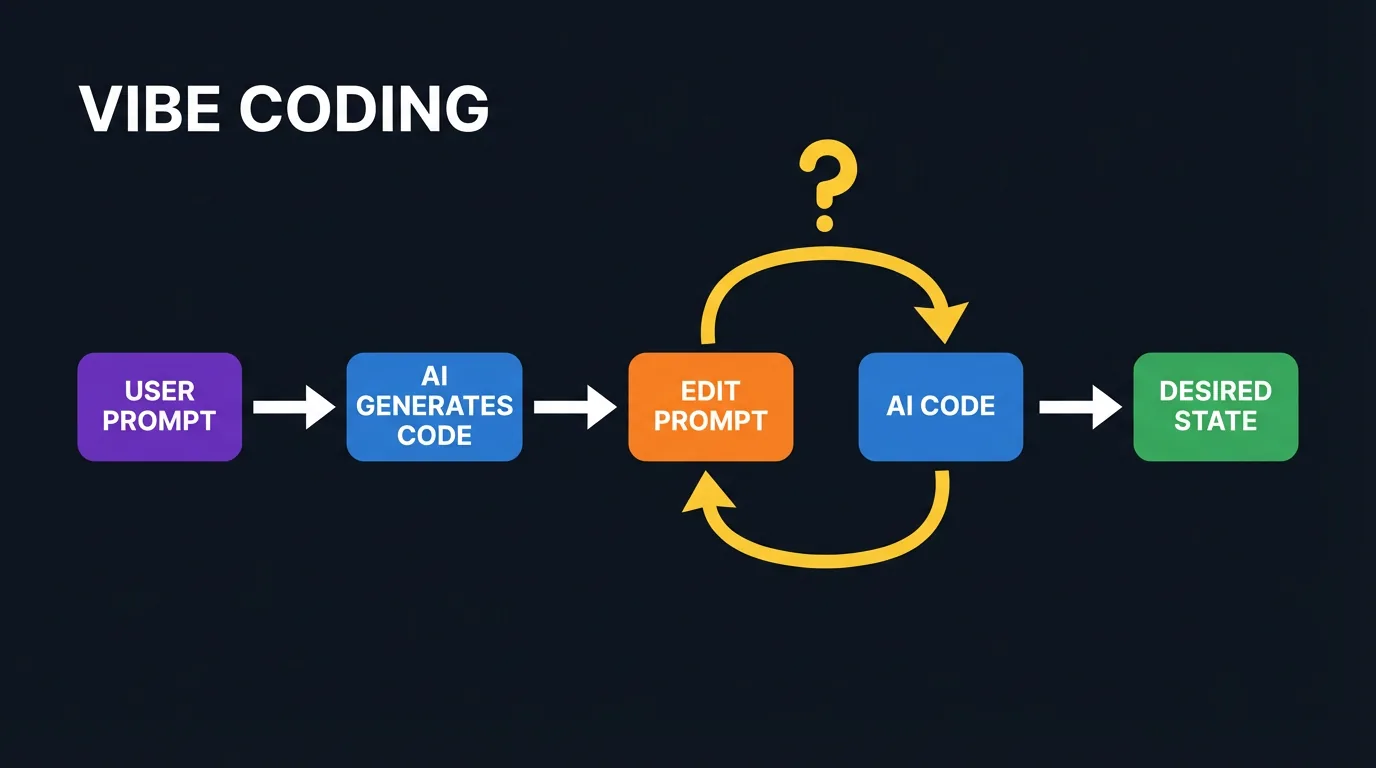
The loop is simple: write a prompt, get AI-generated code, decide if you are happy, edit the prompt if not, repeat. The model drives all the implementation decisions based on your natural language description alone.
The Problem With Vibe Coding
Here is the fundamental issue: how did the model decide to make the specific architectural choices it made? You could run the same prompt a hundred times and get a hundred different implementations. Different libraries, different structures, different trade-offs — each time the model makes a silent decision you were never consulted on.
That unpredictability frustrates developers working on anything beyond a simple prototype. And there is a deeper problem: vibe coding skips the traditional software development lifecycle entirely.
- No requirements phase: The model guesses what you need rather than being told explicitly
- No design phase: Implementation decisions are made implicitly, not deliberately
- No traceability: When something breaks, there is no spec to reference and understand why it was built that way
- High back-and-forth cost: Correcting the model's assumptions after code is written is slower than defining them upfront
For throwaway prototypes, none of this matters. But for anything you intend to maintain, ship to users, or hand off to a team — it matters a lot.
The Traditional SDLC
Before AI, professional software development followed the software development lifecycle (SDLC). The approach has varied over the decades — waterfall, agile, scrum — but the phases are consistent:
- Planning and requirements: What does the system need to do? Document it as a PRD (product requirements document)
- Design: How will it be built? Architecture, data models, interfaces
- Implementation: Write the code against the design
- Testing and QA: Verify the code matches the requirements
- Deployment: Move from dev to staging to production
- Maintenance: Keep it running, fix bugs, add features
Vibe coding largely ignores this. Spec-driven development brings these disciplines back — but with the LLM handling the implementation work.
What Is Spec-Driven Development?
Spec-driven development (SDD) starts not with a prompt for code but with a prompt for a specification. You are not telling the model what to build — you are telling it what the system should do: its behavior, its constraints, its requirements. That specification then becomes a contract.
The contract drives everything downstream: requirements documents, design documents, implementation plans, test cases, and documentation. The LLM is still doing the heavy lifting — generating code, running tests, writing docs — but it is working from an agreed, explicit foundation instead of guessing from a single prompt.
The key difference: nothing is implemented until the spec is approved. At every decision point, you review, approve, or edit before the next phase begins. The model never silently decides how to build your system — you do.
Spec Coding: The Flow
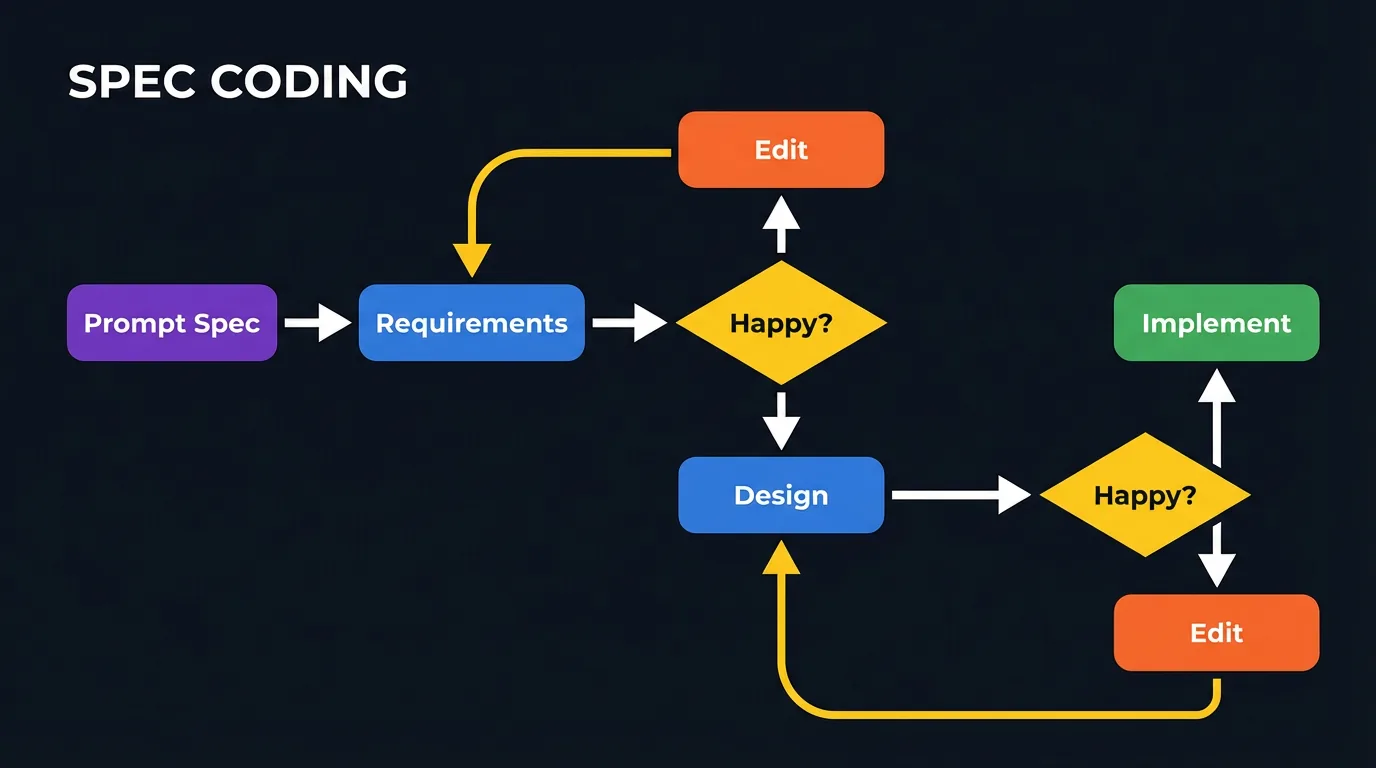
The flow has explicit approval gates. You define a spec, the model generates requirements. If you are happy with the requirements, it generates a design document with implementation to-dos. If you are happy with the design, the model implements. At any point you can edit and loop back — but now you are editing a structured document, not re-prompting from scratch.
This traceability is the core of what makes spec coding powerful. Every implementation decision has a paper trail back to a requirement, and every requirement traces back to the original spec you approved.
Spec Coding vs Traditional Development vs TDD
It helps to place spec-driven development in the context of other approaches:
| Approach | Starting point | Primary artifact | AI role |
|---|---|---|---|
| Traditional development | Intuition, code first | Source code | None / assistant |
| Test-driven development (TDD) | Tests first | Test suite | Optional |
| Vibe coding | Natural language prompt | Generated code | Primary driver |
| Spec-driven development | Behavior specification | Spec document | Implements from spec |
Spec-driven development is essentially test-driven development and behavior-driven development on steroids. You start from what the system must do, make that explicit and approved, then let the model write code that satisfies it. The spec is the primary artifact — not the code, not the tests.
A Practical Example: User Authentication
Consider building a user authentication feature. Here is how each approach handles it:
Vibe coding approach: You prompt the model with "add a /login page for users to authenticate." The model picks a library, decides on session vs JWT, chooses a UI framework, and generates something. It might be fine. It might need three rounds of correction to get what you actually meant.
Spec-driven approach: Before any code is written, you define the spec. The model generates a requirements document from it, something like:
Feature: User Authentication

Endpoint: POST /login
Accepts: { user: string, pass: string }
Success: 200 OK + session token
Failure (missing username): 400 Bad Request
Failure (wrong credentials): 401 Unauthorized

Test cases:
- Valid credentials → 200
- Missing username → 400
- Wrong password → 401
You review this. If it matches what you want, you approve and the model generates a design document. If not, you edit the spec. Only after both are approved does implementation begin — and when it does, there is zero ambiguity about what the model needs to build. The result is deterministic, traceable, and maintainable.
When to Use Each Approach
| Scenario | Best approach |
|---|---|
| Quick prototype to test an idea | Vibe coding |
| Throwaway script or one-off tool | Vibe coding |
| Exploring a library or API | Vibe coding |
| Production feature with defined behavior | Spec-driven development |
| Multi-developer project needing traceability | Spec-driven development |
| Any feature you need to test, maintain, or hand off | Spec-driven development |
| Building an AI agent or complex system | Spec-driven development |
The two approaches are not mutually exclusive. Many teams use vibe coding to explore and spec-driven development to ship. Start fast with vibe coding to validate an idea, then formalize with a spec before production implementation begins.
Watch the Full Breakdown
We covered vibe coding vs spec-driven development in full on our YouTube channel. Watch below for a visual walkthrough of both workflows, the comparison diagrams, and a real example of building a login endpoint both ways:
Conclusion
Vibe coding changed what is possible for builders who can describe what they want. Spec-driven development changes what is possible for builders who want to ship something reliable. The former is great for exploration; the latter is what production software actually needs.
The most important skill in AI-assisted development in 2026 is not writing prompts — it is knowing how to structure your intent clearly enough that an LLM can implement it without guessing. Spec-driven development is that skill, formalized into a workflow.
If you are still vibe coding everything, you are leaving a lot of reliability and maintainability on the table.
Resources
Want AI That Actually Builds What You Mean?
At TecAdRise we design and implement AI-powered workflows and agents using structured spec-driven approaches — so what gets built matches what you actually need. Get in touch.
Get Started